On this page
Fishing is one of the first optional systems in Cozy Grove and one of the last ones you stop using. The loop is short enough for a three-minute break, the collection is deep enough for a year of play, and the by-products feed repair and crafting chains.
The trick is not a secret cast. It is reading three things correctly: the bite, the shadow, and the season.
Unlocking fishing
Captain Billweather Snout introduces the system on the western beach. He asks for a fishing rod, which is sold by Mr. Kit for 20 old coins. The fishing lesson follows. Once you own the rod, you can fish anywhere you find a visible shadow in the water.
The rod does not break. The critter net is also permanent, unlike tools such as the shovel or pickaxe. You can fish with no ongoing repair cost.
The bite window
- Equip the rod.
- Find a fish shadow in the water.
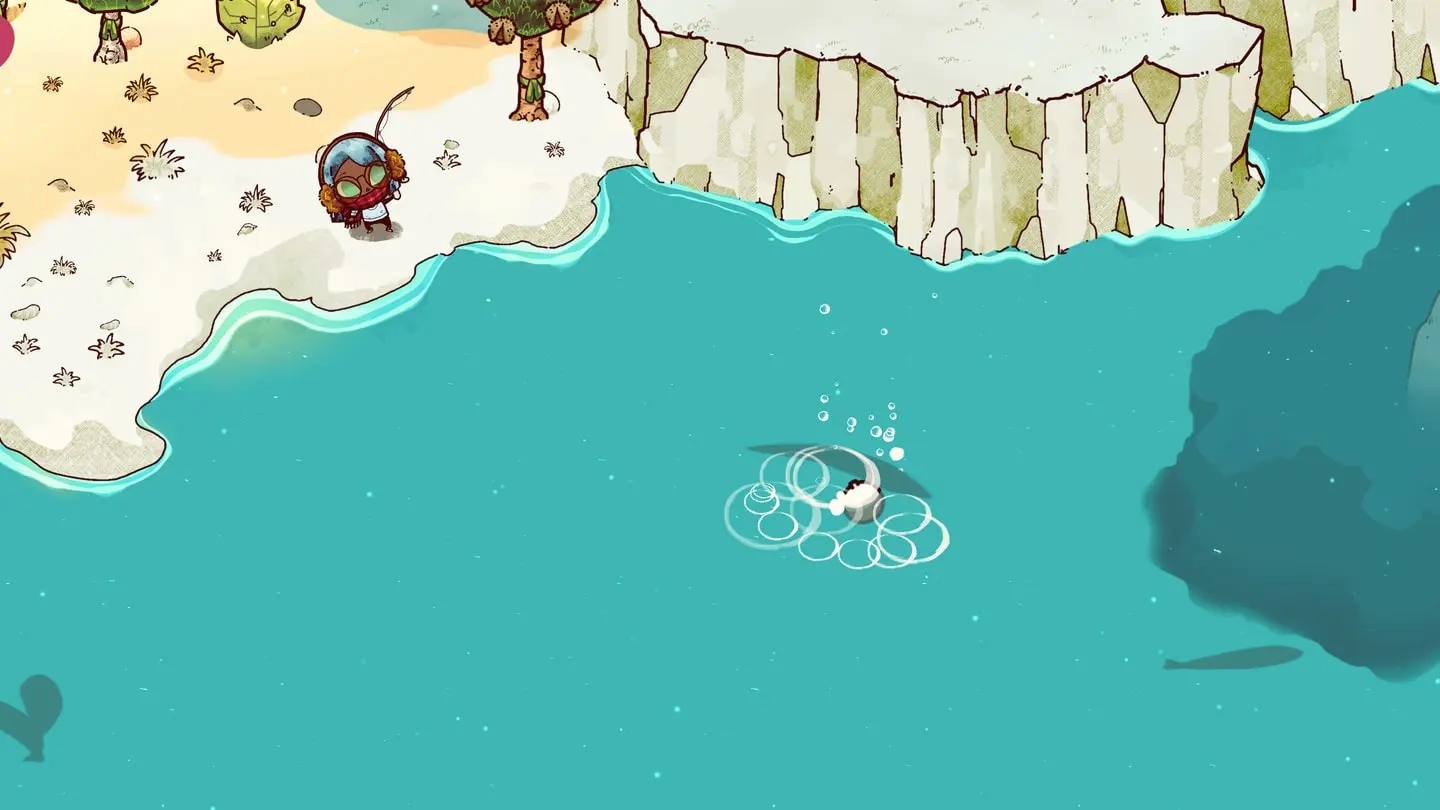
- Cast so the bobber lands close enough for the fish to notice.
- Watch the bobber, not the fish.
- When it is pulled fully under, reel in immediately.
That is the whole mechanic. The difficulty comes from the fish’s behavior. A fish may nibble once or several times before committing. The visual cue that matters is the full dunk.
Normal fish and skittish fish
The community’s fishing notes divide the bite behaviors into two useful ideas:
- Lazy fish are easier to approach. Hitting them with the bobber may not scare them away.
- Energetic fish are more sensitive. The bobber can spook them if it lands too close, or if you place it behind them. Late in the game, Spry Fox notes that “more slippery” fish appear and must have the bobber placed directly in front of them.
If a fish disappears after your cast, do not assume the fish is gone from your save. Move a little, look for another shadow, and adjust the cast distance.
Reading the shadow
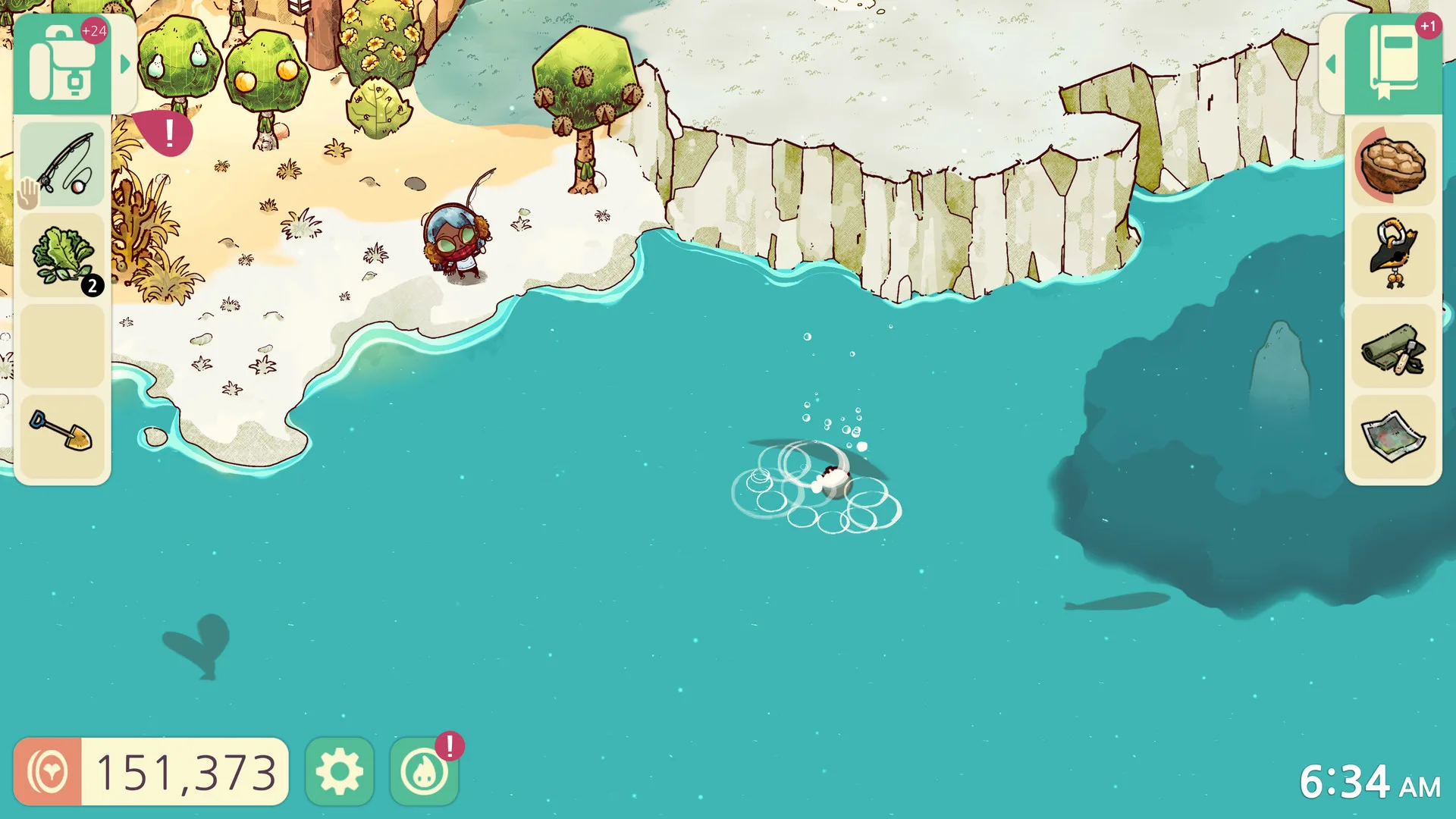
Fish come in three size classes — tiny, middling and huge — and two activity types, lazy and energetic. The shadow shape reflects those traits. The community wiki and Spry Fox’s support notes both use the shadow as a clue to what kind of fish is below.
The practical translation:
- Small shadow: likely a tiny fish.
- Medium shadow: likely middling.
- Large shadow: huge.
- Erratic movement: more likely an energetic fish that needs a careful cast.
- Calm, slow movement: more likely lazy and easier to approach.
There is one more shadow to learn: a rounded blob shape can indicate something other than a fish. The community records that fishing can occasionally produce essence, shells, branches or a recipe instead of a fish. Treat a blob as a bonus, not a failed cast.
The season rotation, without the guesswork
Cozy Grove has 180 fish, split into six seasonal cohorts of 30. Each cohort stays in the water for four months, and two cohorts overlap at any time.
The official rotation dates are:
- January 1 — winter cohort enters
- March 1 — early spring cohort enters
- May 1 — late spring cohort enters
- July 1 — summer cohort enters
- September 1 — early fall cohort enters
- November 1 — late fall cohort enters
The labels are a little unusual, so here is the practical calendar:
| Cohort | Available months |
|---|---|
| Winter | January–April |
| Early spring | March–June |
| Late spring | May–August |
| Summer | July–October |
| Early fall | September–December |
| Late fall | November–February |
Scroll the table sideways to see every column.
This means the fish pool does not change all at once. Roughly half the available fish remain when a new cohort enters, while the other half rotates out. The Fish Finder marks which cohorts are active for your month and lets you filter by size, rarity and behavior.
Are some fish gated by campaign day?
Yes. Spry Fox notes that season is not the only factor: certain fish also require a minimum campaign day. The community wiki records a rough progression where small common and uncommon fish are available first, middling fish appear around day 3, and huge fish begin around day 16.
Those exact day numbers are community-documented rather than an official table. The useful takeaway is that a fish not appearing on day 2 may simply not be unlocked yet, not that your cast is wrong.
Sell, burn or donate?
This is the decision that actually affects your camp.
1. Donate a new species first
Captain Snout’s collection accepts each eligible fish once. Donation rewards scale with size and rarity and can include quartz. A common fish that sells for a handful of coins can still be a useful early collection reward.
Once a fish is in the collection, duplicates are economy stock. Donation rewards are one-time, not a repeatable income stream.
2. Keep quest fish
Bears sometimes ask for fish by size or rarity, not by species. If a request is open, check whether your catch qualifies before doing anything else with it.
3. Burn surplus into charred fishbones
Burning fish at Flamey converts them into charred fishbones, which are used in crafting and tool repairs. The burn yield depends on the fish’s size and rarity. This is often more useful than coins when you are repairing tools or crafting recipes.
4. Sell the rest
Sell raw fish when you need coins. Do not assume burning always produces a better financial return; the fishbone’s value depends on your current needs. The community’s own profit calculations show several cases where burning and selling are equivalent or worse in pure coin terms.
Typical raw sale and burn yield
Format: sale coins / charred fishbones.
| Size | Common | Uncommon | Rare | Legendary | Mythical |
|---|---|---|---|---|---|
| Tiny | 13 / 1 | 25 / 2 | 50 / 3 | 125 / 5 | 500 / 20 |
| Middling | 25 / 1 | 50 / 2 | 100 / 3 | 250 / 5 | 1,000 / 20 |
| Huge | 50 / 2 | 100 / 3 | 150 / 4 | 300 / 6 | 1,050 / 21 |
Scroll the table sideways to see every column.
One-time donation rewards
Format: coins + quartz. The values below are community-documented.
| Size | Common | Uncommon | Rare | Legendary | Mythical |
|---|---|---|---|---|---|
| Tiny | 800 | 1,200 + 6 | 3,000 + 15 | 6,000 + 30 | 15,000 + 60 |
| Middling | 961 | 1,401 + 8 | 3,400 + 17 | 6,600 + 33 | 16,000 + 64 |
| Huge | 1,200 | 1,700 + 9 | 4,000 + 20 | 7,500 + 38 | 17,500 + 70 |
Scroll the table sideways to see every column.
The pattern is clear: a new mythical fish is a significant early-game event. Its donation reward dwarfs the raw sale price. Do not sell a first catch because the coin number looks small.
A good fishing session
A short session can still be productive:
- Check the month on the fish finder.
- Fish for two or three new species, not just whatever bites.
- Donate any new catches.
- Keep quest-sized duplicates if a bear is asking for a size or rarity.
- Burn the rest if you need fishbones; otherwise sell.
- Clear the beach shells on the walk back so new spawns are not blocked.
What not to do
- Do not reel on the nibble. Wait for the dunk.
- Do not sell a first mythical before donating. The collection reward is better than the immediate coins.
- Do not assume a season label matches the weather outside. The fish rotation is on its own calendar.
- Do not burn every fish automatically. Fishbones are useful, but so are coins, quest turns and collection slots.
- Do not trust a single price table forever. A patch or platform build can change values; the fish finder is based on individual records and is easier to audit.
The long game
With 180 fish and a four-month rotation, a complete collection is a multi-month project, not a weekend checklist. The good news is that fishing never becomes obsolete: charred fishbones feed repairs, high-value fish fund purchases, and the collection rewards keep arriving as new cohorts rotate in.
If you want the precise list for your month, use the Fish Finder. If you want the most efficient way to combine fishing with the rest of a session, use the daily routine.
Sources & notes
Linked, dated and labeled
Official sources are used for platform facts, schedule rules and mechanics. Community data is labeled because it is maintained by players rather than Spry Fox.
- Official · Spry Fox Support Tips for getting started in Cozy Grove New-day timing, saving, island structure, color, tools, pets, economy, shell limits, cross-device caveats.
- Official · Spry Fox Support Notes on Seasons Month-to-season mapping, fish rotation dates, four-month fish cohorts, seasonal plants.
- Community · Cozy Grove Wiki contributors Fish (Cozy Grove) The 180-fish dataset: season cohort, size, behavior, rarity, sale price and burn yield. Each fish row was collected from its individual community wiki page on 2026-11-09.
- Community · Fandom contributors Cozy Grove Wiki Community-documented bear roles, quest mechanics, item prices, festival dates, spirit-log requirements. Fan-maintained and not endorsed by Spry Fox. Values reproduced on this site are labeled where they are community data.
- Official · Spry Fox Support Cozy Grove Patch Notes Version timeline and update descriptions.
- Store listing · Valve / Spry Fox Cozy Grove on Steam Platform, release date, price, features, system requirements, screenshots.